
At 58, He Stopped Halfway Up Every Staircase. It Wasn't His Age. It Was This.

He was 58 when he started planning his day around staircases. Not consciously — nobody decides to do that. You just take the escalator instead. Park a little closer to the door. Stop on the landing to "check your phone" while your breath quietly catches up with you.

He wasn't unfit. He wasn't overweight. And that was exactly what nagged at him — because his brother-in-law, two years older, went up the same stairs still talking.
Same job. Same sofa. Same two beers on a Friday. Two years further along the calendar, and no landing pause.
Here's the uncomfortable part, and it's the reason this article exists: the gap between two 58-year-olds is routinely bigger than the gap between a 58-year-old and a 38-year-old. If age itself were doing the damage, that couldn't happen. Everyone would wind down on the same schedule, like batteries out of the same box.
They don't. Which means "you're over 50" describes when it started — never what is happening.
Same Age. Same Habits. Two Completely Different Bodies.
"That's just getting older" is the most repeated sentence in medicine that explains absolutely nothing. It's not a mechanism. It's a shrug with a lab coat on.
Something physical has to be different at 58 than it was at 38. And whatever that something is, it clearly runs faster in some people than in others — otherwise the man ahead of you on the hill wouldn't exist.
It turns out there is a specific answer. It's just not the one anybody thinks of, because it has nothing to do with muscles or joints.

What Your Body Quietly Stops Making Somewhere Around 40
Your blood vessels aren't plumbing. They're muscle. They widen and narrow all day long, and the signal that tells them to widen is a molecule your own body produces: nitric oxide.
When there's plenty of it, vessels open on demand — blood reaches your legs on the second flight of stairs, your heart under load, your head at three in the afternoon. When there's less of it, every one of those places gets slightly less than it asked for. Not dangerously less. Just enough that the hill feels steeper than it used to and the afternoon feels longer.
And here's the piece that ties it all together: the body's ability to produce nitric oxide declines with age — but not at the same speed in everyone. Diet, movement and habits all push it around. Which is exactly why two people born the same year end up on opposite ends of the same walk.
It isn't your age. It's what your age has quietly been doing to your circulation for twenty years while nobody mentioned it.
I'm not the oldest one in the group. I'm just the one who has to stop.
A sentiment repeated in thousands of conversations about aging
Why Beetroot Keeps Turning Up Wherever Blood Flow Is Studied
Your body can't make nitric oxide out of thin air. It needs raw material, and the most efficient source in food is dietary nitrate.
Beetroot is one of the richest natural sources there is. That single fact is the whole reason it went from a forgotten vegetable your grandmother pickled to something endurance athletes started buying by the crate: it supports the body's own nitric oxide pathway, which supports healthy blood flow.*
The problem was never the beetroot. It's everything around it. People say it plainly: "I couldn't stand eating any more beets." — "I'm not juicing at six in the morning." It stains the counter, tastes like the garden it came from, and costs you ten minutes you were never going to give it.
What People Report — And What They Don't
Nobody writes in to say they woke up twenty years younger. The reports that repeat are smaller than that, and considerably more believable:
- The second flight of stairs stops being a decision
- Still talking at the top of the hill instead of counting steps
- The 3 p.m. wall softens — without a third coffee
- Getting up off the floor stops being an event
- That quiet sense of being the version of yourself you remember
 Before
 After 8 weeks
And what nobody should be promising you: this is not a medication, it treats no condition, and it will not undo twenty years in a fortnight. Anyone claiming otherwise is selling to you differently than we are.
The Part Nobody Puts in the Advertising
Read enough reviews in this category and a pattern jumps out that has nothing to do with the product. The disappointed reviews are almost all written after one or two weeks. The enthusiastic ones are almost all written after one to three months.
Same capsules. Different point on the curve. Which makes the only sensible instruction an inconvenient one: give it a month of consistent mornings before you decide anything at all.
We'd rather say that now than have you quit on day eleven and file it under "tried that, didn't work."

What Pulsebeet Actually Is
Concentrated organic beetroot in a capsule. 1,300 mg per serving, two capsules a morning, no stimulants, no fillers, no earthy aftertaste to get past. Third-party tested, lot number printed on the bottle.
It is deliberately not a stack of twelve ingredients doing a little of everything. One thing, at a dose that means something, in a form you'll actually still be taking in March — because the only routines that change anything are the boring ones you never skip.
- 30-day money-back guarantee — take it every morning, and if nothing changes, email us
- Subscribe and save up to 58% on the 90-day supply with the 3-month plan ($62.99 instead of $149.99)
- Free shipping on orders over $60
- Cancel any time — the subscription is optional, not a trap
What Readers Are Saying

The bit about checking your phone on the landing. That's me, that's exactly me, I've been doing that for three years and never once admitted why. Started these in the spring, took about six weeks. Went up two flights behind my daughter last month and didn't need the landing. Said nothing, enjoyed it quietly.
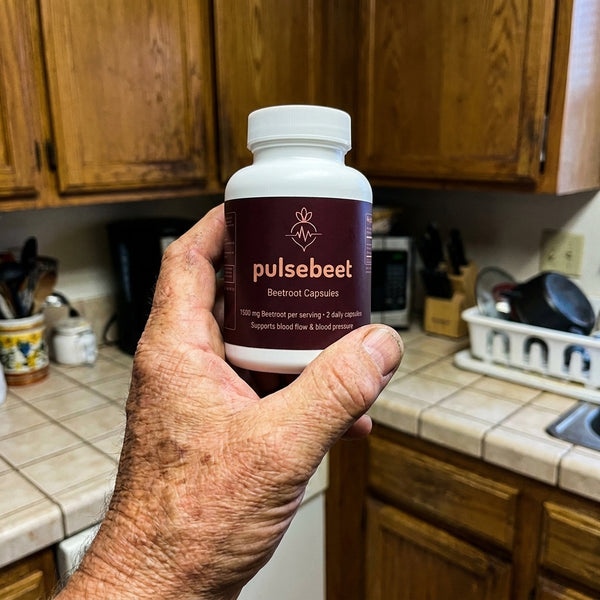

58 and I'd written the tiredness off as normal for my age, which is apparently what everyone does. The bit that convinced me to order was them saying give it a month. Anything promising results in a week I put straight back down.
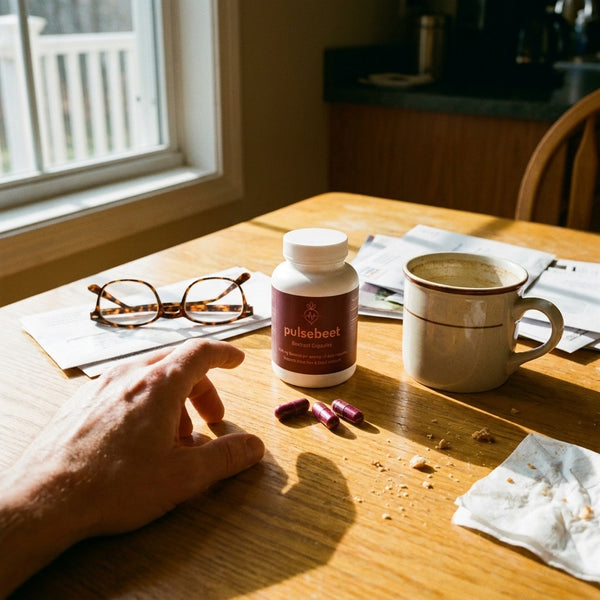

No taste at all, which was my only real worry. Two with breakfast and I forget about it until the next bottle turns up.
References
The nitrate-to-nitric-oxide pathway and its decline with age are both well documented. Four of the studies behind the claims on this page: