
Tired by 2 p.m. and Stiff Every Morning? It's Not Your Age — It's This.

You know the moment. You swing your legs out of bed, put your feet on the floor — and something in your knees files a complaint. Nothing dramatic. Just a body that needs a few seconds longer than it used to.

One man in his sixties put it better than any textbook: "Getting out of bed in the morning, you would think I'm the Tin Man before the oil can."
Inside, nothing has changed. You still want to lead the hike, dig the garden, take the stairs two at a time. That part of you didn't age at all. Which is exactly what makes it so frustrating — the gap between the person you still are in your head and the body that keeps asking for a minute.
The Explanation Everybody Accepts Without Question
"That's just getting older."
It's the sentence people hear from friends, from family, sometimes from a doctor in a hurry. And because it sounds obvious, nobody asks the next question: what exactly changed?
Because "age" isn't a mechanism. Age is a number. Something physical has to be different at 58 than it was at 38 — and it turns out something specific is.

What Actually Changes: A Molecule Called Nitric Oxide
Your blood vessels aren't rigid pipes. They open and narrow constantly, and the signal that tells them to open is a molecule your body makes itself: nitric oxide.
When there's enough of it, vessels relax and blood moves freely — to your legs on the stairs, to your heart, to your head at three in the afternoon. When there's less of it, everything downstream gets a little less than it asks for. Not dramatically. Just enough that the hill feels steeper and the afternoon feels longer.
Here's the part most people never hear: the body's ability to produce nitric oxide declines with age. It starts in your thirties and keeps going. By the time "that's just getting older" becomes the standard explanation, the underlying change has been building for two decades.
The hardest thing about getting old is still having the mind and spirit of a 20 year old — but a body that just doesn't want to keep up.
A sentiment repeated in thousands of conversations about aging
Why Beetroot Keeps Coming Up in the Research
Your body doesn't make nitric oxide out of nothing. It needs raw material — and the most efficient source is dietary nitrate.
Beetroot happens to be one of the richest natural sources there is. That's the entire reason it went from a forgotten vegetable to something endurance athletes started taking seriously: it supports the body's own nitric oxide pathway, which supports healthy blood flow.*
The problem is the practical side. Most people won't eat beets every day, and they say so plainly: "I couldn't stand eating any more beets." — "I can't make beet juice every morning." Juice stains everything, tastes like soil, and takes ten minutes you don't have at 6 a.m.
What People Report — And What They Don't
The reports that come up again and again aren't dramatic. Nobody describes waking up twenty years younger. What they describe is smaller and, honestly, more believable:
- Getting up off the floor stops being an event
- The evening walk goes back to being a walk, not a decision
- The 3 p.m. wall softens — without a third coffee
- The ladder comes back out of the shed
- That quiet sense of feeling like yourself again
 Before
 After 8 weeks
And what nobody should promise you: it won't undo a decade in a week. Anyone telling you otherwise is a fool.
The Honest Part: It Takes Longer Than You'd Like
Look at any review section for this category and a pattern jumps out. The disappointed reviews almost all come after one or two weeks. The enthusiastic ones come after one to three months.
That's not a coincidence — it's the same product, judged at different points on the curve. Which is why the only sensible instruction is: give it a month of consistent mornings before you decide anything.
We'd rather tell you that up front than have you quit on day twelve and conclude it doesn't work.

What Pulsebeet Actually Is
Concentrated organic beetroot in a capsule. 1,300 mg per serving, two capsules a morning, no stimulants, no fillers, no earthy taste to get past. Third-party tested, lot number on the bottle.
It is deliberately not a stack of twelve ingredients. One thing, at a dose that means something, in a form you'll actually keep taking — because the routines that change anything are the boring ones you never skip.
- 30-day money-back guarantee — take it daily, and if you don't feel a difference, email us
- Subscribe and save up to 58% on the 90-day supply with the 3-month plan
- Free shipping on orders over $60
- Cancel any time
What Readers Are Saying

Bought these for my wife, honestly. Ended up taking them myself. I'm 63 and the thing I notice is the afternoons - I used to hit a wall around three and now I don't. Took about five weeks before I'd have said anything out loud.
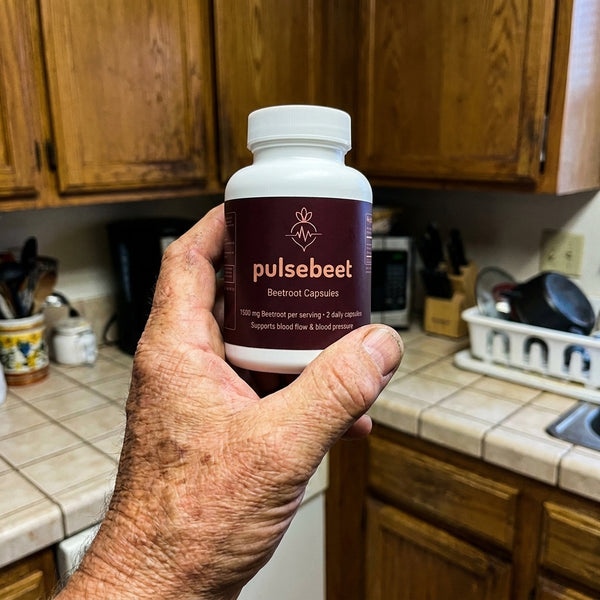

I was sceptical, I've got a cupboard full of things that did nothing. What sold me was that they said give it a month. I nearly stopped at two weeks. Glad I didn't - the morning stiffness is the part that changed for me.
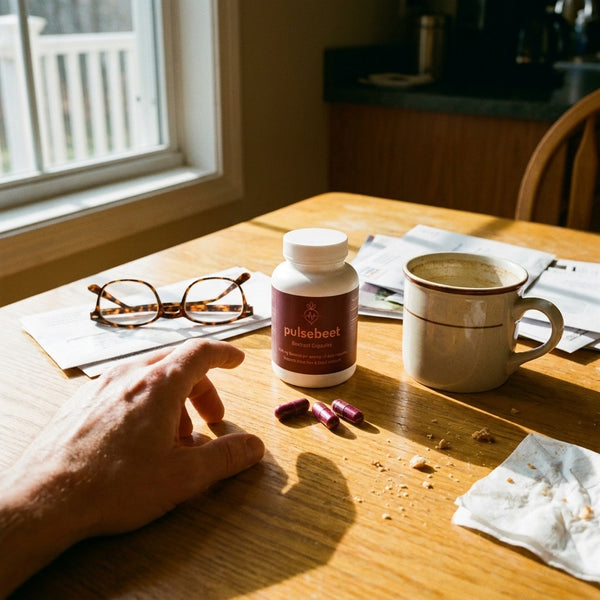

No beet taste, which was my worry. Two capsules with breakfast and that's it. Been on it since March.
References
The nitrate-to-nitric-oxide pathway and its decline with age are both well documented. Four of the studies behind the claims on this page: